
Follow us on social media
Newsletter Subscribe Managed staking across leading PoS networks
Earn on crypto with liquidity pools and managed staking
Choose your path by liquidity needs and risk profile. Track positions with transparent metrics, clear policies, and anytime withdrawals in supported flows.
Pools APY (est.)
8.4–25.9% range · by asset
~20.5% med.
Staking APR (est.)
3.8–21.1% range · by network
~6.7% med.
Assets allocated
across pools · managed staking
$167.85M
Core products
Two ways to earn
Pick the path that matches your liquidity needs and time horizon. Both products run on the same analytics and risk framework.

Liquidity Pools
Estimated APY: 17.32-21.17%
Earn variable yield by providing liquidity to FortisX pools. Returns come from real pool activity under transparent operating rules. Best for: flexible access and active liquidity providers.

Managed Staking
Estimated APR: 9.05-11.07%
Earn network-native staking yield with policy-driven allocation across validators and continuous monitoring. Best for: longer-term allocation with a hands-off setup.
Earn from your idle crypto — add assets to transparent liquidity pools

Ethereum: Easier exits

Solana: Between epochs

Polkadot: Liquidity during exits

Avalanche: Flexible terms

Cosmos: Liquidity upfront

Security & audits
Independent security reviews
External firms reviewed key parts of the platform. Reports are public, and findings include remediation status.
- No critical issues in completed audits
- Medium and low findings remediated before release
- Code, infrastructure, and configs reviewed externally
- Ongoing internal monitoring and periodic reviews
- Public audit reports available for due diligence

CertiK Audit
No critical issues found
Report verified and published

Cyberscope Audit
No critical issues found
Report verified and published
Regulatory Transparency
Regulatory Filings & Public Disclosure
Visible within U.S. regulatory framework.


FortisX Ltd has filed a Form D under Regulation D and is publicly listed in the U.S. Securities and Exchange Commission EDGAR database (CIK: 0002128996).
The filing is also reflected in the North American Securities Administrators Association Electronic Filing Depository (EFD), making it accessible to U.S. state regulators.
This ensures that the company’s filing is visible within the U.S. regulatory framework at both federal and state levels.
SEC Filing
Form D
State-Level Access
Team
The people shaping staking and liquidity at FortisX








Explore earning options
Compare staking and liquidity pools and start with the option that fits your goals.
| Asset | Type | Est. APR* | Est. APY* | Multi-Asset |
Type Liquidity pool | Est. APR* ≈ 20.91% | Est. APY* ≈ 23.25% | Multi-Asset | |
Type Liquidity pool | Est. APR* ≈ 17.12% | Est. APY* ≈ 18.67% | Multi-Asset | |
Type Liquidity pool | Est. APR* ≈ 20.88% | Est. APY* ≈ 23.21% | Multi-Asset | |
Type Managed staking | Est. APR* ≈ 3.8% | Est. APY* | Multi-Asset | |
Type Liquidity pool | Est. APR* ≈ 19.45% | Est. APY* ≈ 21.47% | Multi-Asset | |
Type Liquidity pool | Est. APR* ≈ 21.94% | Est. APY* ≈ 24.52% | Multi-Asset | |
Type Liquidity pool | Est. APR* ≈ 23.03% | Est. APY* ≈ 25.89% | Multi-Asset | |
Type Liquidity pool | Est. APR* ≈ 20.18% | Est. APY* ≈ 22.36% | Multi-Asset | |
Type Liquidity pool | Est. APR* ≈ 15.7% | Est. APY* ≈ 16.99% | Multi-Asset | |
Type Managed staking | Est. APR* ≈ 6.06% | Est. APY* | Multi-Asset | |
Type Liquidity pool | Est. APR* ≈ 19.49% | Est. APY* ≈ 21.51% | Multi-Asset | |
Type Liquidity pool | Est. APR* ≈ 17.81% | Est. APY* ≈ 19.49% | Multi-Asset | |
Type Liquidity pool | Est. APR* ≈ 20.51% | Est. APY* ≈ 22.76% | Multi-Asset | |
Type Liquidity pool | Est. APR* ≈ 22.05% | Est. APY* ≈ 24.66% | Multi-Asset | |
Type Liquidity pool | Est. APR* ≈ 19.2% | Est. APY* ≈ 21.16% | Multi-Asset | |
Type Liquidity pool | Est. APR* ≈ 18.07% | Est. APY* ≈ 19.8% | Multi-Asset | |
Type Liquidity pool | Est. APR* ≈ 9.86% | Est. APY* ≈ 10.36% | Multi-Asset | |
Type Liquidity pool | Est. APR* ≈ 20.55% | Est. APY* ≈ 22.81% | Multi-Asset | |
Type Liquidity pool | Est. APR* ≈ 14.38% | Est. APY* ≈ 15.46% | Multi-Asset | |
Type Managed staking | Est. APR* ≈ 6.72% | Est. APY* | Multi-Asset | |
Type Liquidity pool | Est. APR* ≈ 10.44% | Est. APY* ≈ 11% | Multi-Asset | |
Type Liquidity pool | Est. APR* ≈ 17.96% | Est. APY* ≈ 19.67% | Multi-Asset | |
Type Liquidity pool | Est. APR* ≈ 21.32% | Est. APY* ≈ 23.75% | Multi-Asset | |
Type Managed staking | Est. APR* ≈ 21.06% | Est. APY* | Multi-Asset | |
Type Liquidity pool | Est. APR* ≈ 22.16% | Est. APY* ≈ 24.79% | Multi-Asset | |
Type Managed staking | Est. APR* ≈ 12.67% | Est. APY* | Multi-Asset | |
Type Liquidity pool | Est. APR* ≈ 15.7% | Est. APY* ≈ 16.99% | Multi-Asset | |
Type Liquidity pool | Est. APR* ≈ 14.24% | Est. APY* ≈ 15.29% | Multi-Asset | |
Type Liquidity pool | Est. APR* ≈ 13.18% | Est. APY* ≈ 14.08% | Multi-Asset | |
Type Liquidity pool | Est. APR* ≈ 8.03% | Est. APY* ≈ 8.36% | Multi-Asset | |
Type Liquidity pool | Est. APR* ≈ 11.5% | Est. APY* ≈ 12.18% | Multi-Asset |
* Estimated APR/APY are variable and may change over time.
Quick start
Start in minutes
Create an account, choose staking or pools, and start in one clear flow.

STEP 1
Create a free account
Use email or Google sign-in to access your FortisX dashboard.

STEP 2
Choose your option
Choose between Liquidity Pools or Managed Staking.

STEP 3
Earn rewards
Track performance in your dashboard in real-time.
Compare options
See how FortisX stacks up against other staking choices.
Options
Rule visibility
Diversification controls
Monitoring & Alerts
Operational overhead
Liquidity / Exits
Data & Integrations
FortisX Managed Staking
Rules and limits shown
Built-in targets
Built-in monitoring
Low maintenance
Instant exit*
App & API access
Native Staking
Validator choice
Manual
Self-managed
Higher effort
After unbonding
Basic explorers
Exchange Staking
Provider terms
Provider-defined
Platform notifications
Simple setup
Platform withdrawal timing
Limited access
Liquid Staking Tokens
Protocol mechanics
Varies by protocol
Community tools
Moderate steps
Sell / swap
DeFi integrations
* Instant exit is provided via FortisX liquidity pools.
How it works
Analytics · Staking · Pools
A single workflow that connects on-chain analytics with allocation rules and liquidity.
Analytics
FortisX turns on-chain validator and network data into risk indicators used by allocation rules.
Managed staking
Allocation rules set diversification and concentration limits across validators and are re-applied as conditions shift.
Liquidity pools
Pools provide operational liquidity around staking, absorbing network timing constraints and delivering variable yield to liquidity providers.
Operational monitoring
Network conditions that shape staking
In staking, a lot is decided by current network conditions: fees, block timing, and validator behavior shift throughout the day. That movement is why staking can feel different from one moment to the next — and why monitoring starts here.
- Fees & block timing — when execution becomes more expensive or more predictable.
- Validator set & staking ratio — how broad participation looks in the current state.
- Operator concentration — where exposure is building (used in allocation limits).
Metrics shown are illustrative.
Operator concentration
Top 1/2/3/4 + Others
Top 1
17.868%
Top 2
6.381%
Top 3
3.771%
Top 4
1.224%
Others
70.755%
Featured in press
Media & industry mentions
A curated list of external articles and research that reference FortisX. The views expressed belong to the respective authors.

FortisX.fi: Where Professional-Grade Staking Finally Meets...
In a market still obsessed with flashy token launches and unsustainable farming yields, most serious crypto holders quietly face the same frustration: their assets sit idle or locked up in rigid staking positions while network unbonding periods drag on for weeks...

The Rise of Yield Infrastructure for Long-Term XRP Holders...
The cryptocurrency market has historically rewarded patience. Many investors have built long-term positions in assets such as Bitcoin, Ethereum and XRP, holding them across multiple market cycles in anticipation of structural adoption. However, this strategy introduces a structural inefficiency...

The rise of yield infrastructure for long-term crypto holders...
The cryptocurrency market has historically rewarded long-term investors. Many of the most successful strategies in the space have been remarkably simple: buy high-conviction assets and hold them through multiple market cycles. However, this strategy....

Independent Review: FortisX Strengthens Its Position With...
In a digital landscape filled with short-lived crypto experiments and overpromising startups, fortisx.fi appears to be carving a different path. The project, which focuses on building reliable Web3 infrastructure, recently underwent and...

FortisX Review (2025): A Deep Dive Into the Infrastructure...
FortisX has emerged as a quietly growing but increasingly relevant infrastructure provider in the Proof-of-Stake (PoS) ecosystem. With roots dating back to 2018, the company has gradually expanded its presence across multiple...

FortisX Expands Industry Collaborations — Engaging with...
Since its inception in 2021, FortisX has evolved from a staking analytics platform into one of the most comprehensive infrastructure hubs in the digital asset ecosystem. Built on transparency, security, and technology-driven efficiency...

FortisX: Yield on a staking base with product liquidity...
Staking is easy to grasp at the idea level: an asset participates in a network and earns rewards. In practice, staking has a defining trait — it follows protocol timing. Entering and exiting can take time, and position management...

FortisX: Building Predictable, Risk-Controlled Infrastructure...
The institutional side of Proof-of-Stake has grown rapidly, but few companies have approached it with the level of engineering discipline expected in traditional enterprise infrastructure. Since 2018, FortisX has been quietly developing systems...

Research Preview: FortisX Staking Stack and Liquidity Layer...
An upcoming brief outlines how FortisX monitors validator risk signals, keeps allocations aligned to explicit rules, and uses an internal liquidity layer to improve entry and exit timing across supported networks...

Data Note: On-Chain Metrics Behind Validator Quality Scoring...
This planned note summarizes the signals used to evaluate uptime, decentralization, concentration, and operational incidents in PoS networks, and how FortisX turns those inputs into repeatable allocation policies...

Explainer: Staking Risk Signals Investors Can Verify On-Chain...
A forthcoming explainer walks through participation, fee dynamics, validator incidents, and concentration measures, showing how to read these signals before selecting a validator set or staking pool for a given network...

Since 2018, FortisX has focused on designing structured liquidity...
Since 2018, FortisX has focused on designing structured liquidity environments rather than marketing-driven reward models. At the center of the platform’s infrastructure is HIT Protocol — a liquidity coordination framework developed to balance capital efficiency, flexibility...
Ecosystem & data sources
Current and planned integrations
FortisX is built to work with established data providers and infrastructure platforms used across the industry. Current coverage is complemented by integrations in development.
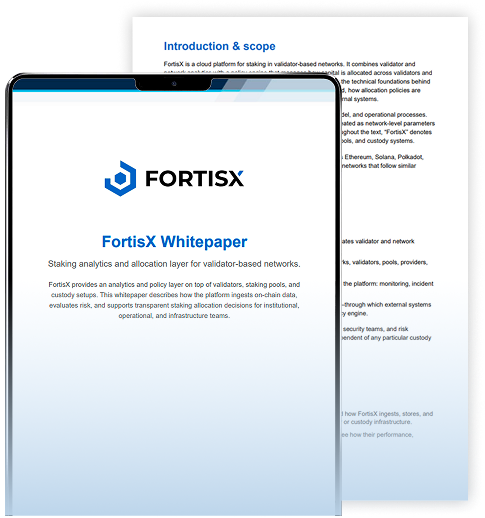
Whitepaper
The whitepaper details our data model, policy engine, and operational discipline behind FortisX.
Outline
PDF
~135 KB
60 Pages
- Intro & scope
- Legal notice & risks
- Platform overview
- Architecture & data flow
- Data model & entities
- Validator metrics
- Network & decentralization
- Risk modeling
- Policy engine & rules
- Operations & reliability
- Security & audits
- Analytics API & roadmap
API access for developers
API access — real-time blockchain analytics
Plug FortisX network and validator datasets into your product: live conditions, concentration signals, and historical context across supported chains.
The FortisX Analytics API provides network-level aggregates, validator KPIs, and event signals in a consistent schema. Official SDKs for JavaScript, Go, PHP, and Python speed up integration, while HMAC-signed webhooks cover alerts and automation workflows.
Endpoints and examples are documented in GitBook and the SDK repositories.
Real-time endpoint example
curl
https://api.fortisx.fi/v1/networks
curl -s https://api.fortisx.fi/v1/networks \
    -H "Authorization: Bearer <API_KEY>"
[
{"code": "ETH", "status": "Stable", ...},
{"code": "SOL", "status": "Low Load", ...},
{"code": "DOT", "status": "Stable", ...},
{"code": "AVAX", "status": "Stable", ...},
{"code": "ATOM", "status": "Low Load", ...},
...
] Blog
Research & guides
Practical notes on how staking behaves in the real world — signals, incidents, and the rules built from them.
Monitoring
4 min read
May 12, 2026
Latency in Validator Operations: Why Network Propagation Matters
Validator infrastructure operates inside globally distributed peer-to-peer networks where communication timing shapes how quickly consensus forms. Every block proposal, vote, ...

Data Methodology
4 min read
Apr 30, 2026
Reward Variance in Staking: Understanding Uneven Outcomes Across Validators
Staking dashboards occasionally reveal an observation that appears puzzling at first glance. Two validators with very similar parameters — comparable uptime, stable infrastruc...
Allocation Notes
4 min read
Apr 5, 2026
Rebalancing Validator Allocations: Frequency, Cost, and Policy Discipline
Validator allocations evolve continuously as networks grow. New operators join the validator set, commission schedules change, infrastructure providers expand their presence, ...
Transparency and Control
Stake with clear rules, backed by real-time signals
Clear rules
Allocations follow explicit, auditable policies. Changes stay predictable and easy to explain.
Custody-grade security
Key custody is handled via Fireblocks (MPC) and kept separate from staking operations.
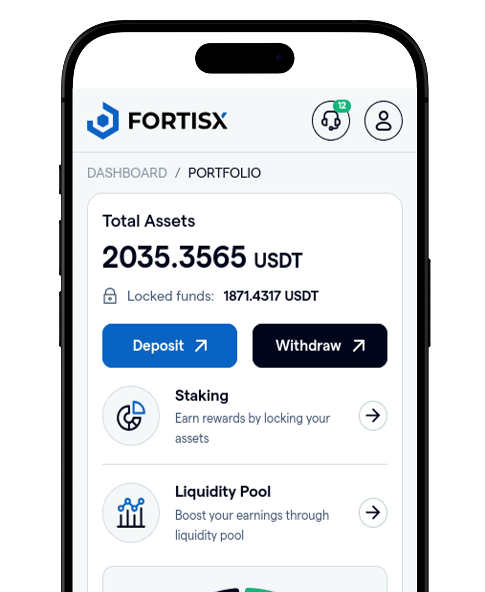
Full visibility
You can see what is allocated where, and why. Monitoring and alerts support decisions without extra tools.
Metrics-driven adjustments
Live validator and network metrics guide rebalancing. Risk and concentration stay within defined limits.
Managed staking