Analytics & allocation for staking

Managed staking in supported networks

FortisX adds an analytics and allocation layer on top of staking networks. You choose the networks and funding assets; the engine distributes stake across validators and pools inside each network, while an internal liquidity layer smooths entry, exit and reward payouts.
Aggregated analytics are derived from the same on-chain data that powers the internal allocation engine and are also accessible via API.
On-chain data points
2.3B+
Alerts tracked
3.1M+
Validators monitored
2.2K+
Networks covered
5
One allocation engine, shared data and models across supported networks.
Aggregated analytics are derived from the same on-chain data that powers the internal allocation engine and are also accessible via API.
Managed staking

What managed staking means

You choose networks and funding assets, while the engine and liquidity layer manage allocations, timing and payouts inside each supported network.

You choose networks and assets
Select the networks you want to participate in, decide how much to allocate and pick supported assets for funding and payouts.
The engine allocates inside each network
The allocation engine distributes stake across validators and pools within each network, following performance, risk and decentralization metrics instead of manual picks.
A liquidity layer handles timing and flows
An internal liquidity layer bridges lockups and reward timing, enabling faster entry and exit, instant-unstake options and smoother payouts in supported assets.
Data and policies stay transparent
The same on-chain data and allocation rules that drive the engine are visible in analytics and available via API, so decisions can be understood and audited.
Managed staking

How managed staking works

Once your preferences are set, managed staking in runs as a continuous loop of data collection, allocation decisions, on-chain execution and reporting inside each supported network.
The engine continuously ingests on-chain metrics and events for validators, pools and networks.
Risk and allocation rules turn these inputs into target weights for validators and pools inside each network.
Staking, rebalancing and liquidity operations are executed on-chain to move positions toward those targets without leaving capital idle.
Current staking positions and reward flows are kept in sync with on-chain data and shown as aggregated views in dashboards and API.
Diversification Strategy

Diversified exposure across validators and providers

Validator and yield-bearing networks differ in behaviour, risk profile and reward patterns. Within each selected network, -managed staking spreads stake across multiple validators and providers and maintains diversification according to explicit limits and risk bands.

  • Per-network allocations are spread across multiple validators and providers, with caps on how much stake any single operator can hold.
  • Allocation policies can favour factors such as long-term performance, decentralization metrics or operator type, depending on the mandate.
  • As on-chain conditions change, the engine gradually rebalances inside each network to keep allocations within predefined ranges.
  • The same diversification rules apply to direct validator positions and to exposure obtained through providers or pooled products.
$112.93B+
Total value staked
Ethereum (ETH)
$79.50B
Solana (SOL)
$30.66B
Polkadot (DOT)
$820.45M
Cosmos (ATOM)
$582.52M
Avalanche (AVAX)
$1.37B
Protocol-level view

Staking participation across networks

keeps a cross-network view of staking participation, tracking how much of the circulating supply is staked in each chain, how that stake is distributed, and how these patterns evolve over time. These signals frame network security and the effective capacity for additional stake, and they provide the macro context for risk budgets, policy ranges, and the allocation models maintains inside every supported network.

Network signals & dynamics

Real-time network monitoring

FortisX maintains a continuous stream of on-chain signals for each supported network, tracking how validator sets, reward flows, commission schedules and protocol parameters change over time. Each update is captured as a structured event that describes how the chain behaves under real conditions, and these signals form the live context for network-level risk limits and allocation policies.

  • Validator downtime, performance degradation, or slashing-related events
  • Sudden shifts in reported rewards, payout cadence, or effective yield patterns across the network
  • Changes to commission schedules or fee policies of major validators and pools
  • Protocol and governance updates that affect staking rules, economic parameters, or validator set requirements
Validator & pool analytics

How the staking engine sees each network

Validator, pool, and decentralization metrics that describe how stake is distributed within a network and feed the allocation and policy models used by the staking engine.

Decentralization metrics

Active Validators
888520
Total Supply
122.37M
Total Staked
39.15M
Staking Ratio
0%

Provider concentration

Provider A/B/C + others
Provider A
19.655%
Provider B
6.939%
Provider C
4.183%
Provider D
1.259%
Others
67.964%

Top staking pools

Provider
Lido stETH
$20.25B 19.654969% 2.51% 10%
Wrapped Be...
$6.31B 6.93861% 2.4% 10%
Etherfi eE...
$3.31B 4.183489% 2.8% 10%
Kelp rsETH
$1.05B 1.25865% 2.57% 10%
LsETH
$766.77M 0.761292% 3.09% 10%
Coinbase W...
$671.18M 0.860501% 3.17% 10%
Rocket Poo...
$642.12M 0.83389% 1.92% 14%
StakeWise ...
$311.37M 0.316959% 2.33% 5%
Stader ETH...
$185.73M 0.245205% 2.16% 10%
Frax Ether
$113.49M 0.144904% 2.46% 10%
Flow & concentration analytics

Validator & Network Activity Monitor

FortisX aggregates on-chain movements in delegated stake and validator balances into activity profiles for each supported network. Whale-level flows, shifts between validators and pools, and changes in net staking or unstaking are transformed into time series that show how concentration and participation evolve over time.

These patterns help identify when large positions begin to accumulate, unwind, or rotate across providers, and how often networks experience periods of heightened flow. The resulting signals feed into risk reviews, capacity and infrastructure planning, and periodic checks of allocation and concentration limits inside each chain.

Whale Alerts Analytics
Positive Events
Negative Events
Unified staking portfolio
A single view of all staked balances under a programme, with totals by network and asset.
Network and asset breakdown
High-level distribution of positions across supported networks and funding assets, without managing validators directly.
Reward flows and cadence
Clear record of rewards and how payouts are processed over time.
Position lifecycle view
Visibility into entries, exits, scheduled unlocks, and other lifecycle events for staking positions.
Staking portfolio view

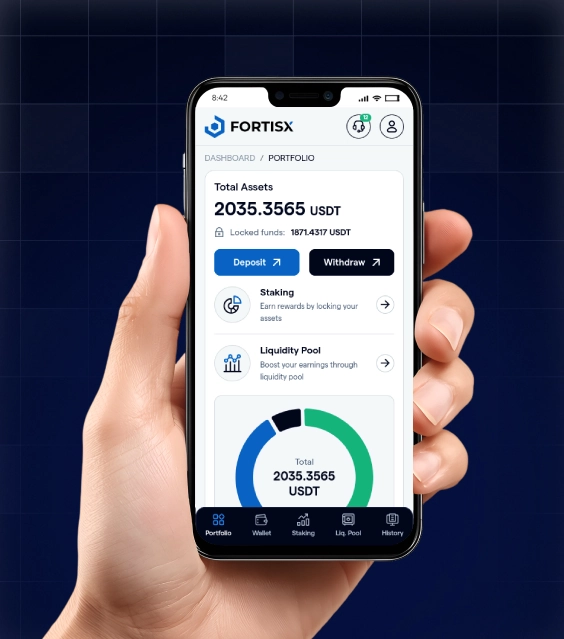
Dashboard for managed staking positions

The dashboard presents managed staking as a single portfolio rather than a set of separate validator positions. Participants see where capital is staked across networks, how it is distributed within a programme, and how rewards and lifecycle events accumulate over time.

The underlying analytics and policy framework operate in the background, so the interface stays focused on positions, flows, and programme status.

Institutional solutions

Institutional access to the staking layer

Institutional clients use the same managed staking engine as individual participants, with additional controls for mandates, oversight, and integration into existing risk and reporting processes.

Segregated mandates & controls

Staking programmes can be kept separate across networks, each with its own limits, eligibility rules, and approval flows. Role-based access clarifies who is responsible for configuration, day-to-day operations, and periodic reviews.

Risk & reporting toolkit

Managed staking positions are linked to internal risk and finance processes through dedicated data interfaces and scheduled reports. Positions, flows, and policy status can be reconciled with existing risk frameworks and portfolio views.

Integration into existing stacks

Data on staking positions, rewards, and lifecycle events is available for ingestion into portfolio systems, data warehouses, or custom dashboards, so the staking layer can be embedded into existing infrastructure without changing how teams and clients operate.
Our staking approach

Building the analytics and allocation layer for staking

Our Mission
FortisX aims to make staking more transparent, data-informed, and operationally robust. The platform connects validator-level infrastructure with explainable analytics and automated allocation so that participation in validator-based ecosystems can follow clear rules and not rely on ad-hoc decisions.
In practice
Within each supported network, users work with a single managed staking flow. The platform handles allocation and adjustment of positions between validators and pools, while access to underlying metrics and events is available through API for teams that prefer to build their own views and reporting.
FAQ

Frequently Asked Questions

When you stake through FortisX, capital is allocated into native staking positions (or strategies built on top of them) inside each selected network. The analytical and allocation engine decides how to distribute this capital across validators and providers according to configured policies and on-chain metrics. Positions are then monitored over time, and the engine can revise allocations within the same network when the data justifies a change.
Staking via FortisX is built around a portfolio approach inside the network. Instead of locking everything to one validator, the engine can spread capital across multiple validators and providers, taking into account participation, performance, commissions, stake concentration, and other metrics. These allocations are not static: they can be revisited as the data changes, while the positions remain native to the chain.
Each network keeps its own unbonding rules and timelines, and FortisX does not override them. The engine is aware of these parameters and takes them into account when planning reallocations and managing flows between strategies or validators. Where the internal liquidity layer is configured, it can be used to offer faster exits (such as instant-unstake) while native unbonding continues in the background, but the underlying protocol timings stay the same.
Staking always carries protocol and validator risk. Events such as slashing, validator downtime, governance changes, or technical incidents at the network level do not disappear. FortisX uses on-chain data and diversification to manage exposure and to adjust allocations when metrics deteriorate, but it cannot cancel out the fundamental risks of the underlying networks and staking mechanisms.
Staking rewards accrue according to each network’s own rules and are recorded as part of the performance of validators, pools, and strategies. These reward flows become part of the datasets the engine uses when evaluating allocations and comparing options within a network. Where the liquidity layer is active, the same reward streams also feed into the economics of the pools, which can support more predictable payout schedules and, where configured, payouts in supported assets.
Managed staking recap

Key points to remember

Within each network
Stake is spread across validators and providers inside each supported chain.
Operational liquidity layer
An internal liquidity layer smooths entry, exit and reward payouts.
Shared data and models
On-chain metrics feed the allocation engine, dashboards and API through the same data pipeline.
Single flow, portfolio view
For each network you interact with a single managed staking flow and a portfolio-level view of exposure.
Managed staking

Support networks with data-driven staking

We use cookies to operate the site, analyze traffic, and remember your preferences. You can change settings at any time.
Learn More